Sunday, December 11, 2016

From morse code to smartphones and everything in between

BELIEVE it or not, young people, once upon a time there were no mobile phones.
               

When I was a boy, most houses didn’t have a phone and before that nobody had a telephone.

In the early days of Adelaide, the only way to get an urgent message to someone was to run, or ride a horse, and pass the message face-to-face.

Around 1850, if there was a fire, someone would run to the police barracks on North Tce, the duty inspector would send out an officer on horseback to find the constables walking the beat. He would then send them running back to the police barracks to collect the fire pump and either tow it by hand or hitch it to horses and gallop to the fire. Just imagine how long that would take.

As most of Adelaide’s buildings were made of wood and thatch, there wouldn’t be much of the structure left by the time they got water.

When the telegraph was introduced, a message could be sent to a post office using morse code and the message could be delivered by hand. Amazing!

A slight digression. When I started work at 5AD in 1959, and through the 1960s, we were still using morse code to communicate with the regional stations 5PI, 5MU and 5SE.

I got 10 shillings a week to know and use morse code.

Once the telephone came to Adelaide, only government offices and important businesses had the telephone connected.

You didn’t dial a number yourself, you contacted the “operator” in the telephone exchange by winding a little handle and she connected you.

Once people saw how convenient these phone things were, there was a demand.

Even the public wanted to use them, so public phones were introduced, and then phone boxes.

Throughout the city, little steel poles were erected with a box on top. They were police boxes, and suddenly police on the beat were in contact with the City Police Station.

Each officer had a key and they could be alerted or pass messages. It was a revolution.

Later, taxis caught on, and each taxi rank had a series of different coloured boxes to cover the various companies.

Taxis now didn’t have to go back to their depot to get a job.

Not many people could afford to have their own phone. I can remember we would walk about 25 houses away to Mrs Smith, who had a phone for an emergency, or we’d ride a bike around to Henderson’s grocer shop for the nearest phone box.

Wednesday, November 2, 2016

Samsung to cripple its Galaxy Note 7 phone with forced update

Anyone who still has a Samsung Galaxy Note7 had better stay off the internet from November 5. That's when Samsung will start pushing out a firmware update to effectively cripple the recalled phone, all but for forcing owners to bring them in for a refund or exchange for a different phone.
                 

The firmware update, which will install without user permission, limits the charge on the phone to 60 per cent, meaning it typically won't even last a full day between charges.

But Samsung is worried that, if the phone's battery is allowed to charge much more than that, it's at risk of exploding and/or catching fire: a problem that prompted the Note7's worldwide recall, and its almost unprecedented killing off as a product.

Android firmware updates usually require the user's permission before they download and install, but Samsung says that because this update is a "safety measure", it's allowed to push it onto phones automatically. It's already pushed the update onto the original Note7s, and now with this update, it's pushing it onto Note7 devices that were brought back in to have their battery replaced, back when Samsung thought it could simply swap out the defective batteries rather than completely remove the phone from the market.

And, let's face it, anyone who still has a Note7 this far into the incredibly well-publicised recall is holding out  and won't return it without a bit of extra cajoling.

Samsung has been pushing messages twice a week to any phones that are still out there, telling owners to turn them off and bring them in, but apparently that hasn't been enough for some people.

Friday, October 14, 2016

This is NYPD's official crime-fighting phone

That's right, the New York Police Department has finally -- finally! -- caught up with the modern age and equipped its officers with smartphones, nearly a decade after the first iPhone came out. The department began handing out it first smartphones to the city's 36,000 police officers in April 2015 and finished equipping the entire force earlier this year. Now new officers at the New York City Police Academy in College Point, Queens, get phones along with their guns and badges.

Just as the advent of smarter phones brought improvements to regular folks' daily lives, these handsets have likewise made it easier for the city's finest to fight crime. Officers are able to respond to 911 calls faster, solve crimes more efficiently and create stronger ties to their community, according to NYPD.

Solving crimes

The NYPD has already seen tangible benefits of using the phones. In one case, a fare-beating passenger who ran out of a taxi likely would have gotten away if the responding officers didn't have their phones on them.

Instead, officers were able to use the database on their phones to figure out that the thief was hiding in his girlfriend's apartment building right next to where he had run off in Rockaway, Queens.

The thief had used the driver's phone to call his girlfriend before fleeing. Officers ran a search through the NYPD's system with the phone number and found her address through a criminal record.

Strengthening community ties

Among the apps and high-tech additions, the phone's most basic function -- calling -- is what has helped community relations the most.

At the time, it was against NYPD policy to give out personal contact information. Victims who wanted to reach the officers who took their report would have to call the precinct and leave a message, sometimes to voice mailboxes shared by entire squads.

Tuesday, September 13, 2016

The 4 Best Apps To Organise Your Phone's Photos

These four apps are specifically built to organise your photos with very little effort at all.


1) Focus

Focus (Android) lets you take the same approach with your photos that you might do with your Gmail, giving you a customisable labelling system to quickly group your pictures into any kind of bucket you like: photos of the kids, photos from a particular trip, photos with you in them, or just photos that stand out from the rest in your camera’s picture gallery.

2) Cleen

If you’ve ever wanted to sort through your photos using the same at-a-glance appraisals and finger swipes you use to find dates on Tinder, you’re in luck. Cleen (iOS) lets you swipe up to save photos, swipe down to trash them, and swipe left or right if you don’t want to decide right away. There are no albums, no labels, and no extra fuss.


3) Slidebox

Slidebox (Android and iOS) also lets you keep or delete images with a simple swipe of the finger. Additionally, you can place your pictures into specific albums with a tap on the screen, and it has a few more features than Cleen (like an easy album creation menu).


4) Photo File
Photo File (iOS) takes a slightly different approach to sorting your pictures. It asks you to categorise them before you actually take them. You use the app’s own camera to take pictures, and just above the shutter button is the label you’re about to apply. A swipe to the left or the right changes the category, and a tap on the shutter button takes the photo.

Monday, December 14, 2015

What are custom phone skins?

The custom phone skins refer to a thin layer of film which sticks to the surface of the mobile phone, for the purpose of decoration as well asprotect the phone from scratching. The most commonly used material for the custom phone skins are vinyl films, which is no harm to humans and environmental protection. For good quality vinyl films that stick to the mobile phone, they can be easily removed manually without leaving any residue on the cover. Also, good quality custom skins for mobile phone are good for heat dissipating when the mobile phone cover becomes hot due to the mobile phone's CUP occupation is high such as when watching movies or playing games on the smartphone.

Generally speaking, there are 2 different types of custom phone skins.One is the printed phone skins with custom design picture. Another one is directly cut by special texture films without printing.

For the printed custom skins, usually people like to print personal photo or group photo to make it personalized. DAQIN provide high quality white printing design films that can be directly printed by 6 colors inkjet printer. The printing design films from DAQIN are very special. As you know, ordinary vinyl films can't be printed by inkjet printer while DAQIN managed to do it. The ink for 6 colors inkjet printer are dye ink, which has high quality printing effect and the cost for each printing is comparatively low.

After printed, the film needs to be laminate with a thin layer of lamination effect film in order to become water proof and add special textures such as leather, gridding, twill, 3D water drops, glossy, matte, flash-matte, ice-flower…etc.It's cold lamination, no need of turn on heat during the lamination process. DAQIN provide 4 rollers laminator which can effectively avoid bubble. Still, it needs several times of practicing before you become familiar with the operation of laminating.

After lamination, it's time to cut the film into custom phone skins with DAQIN's phone skin software and cutter. Any brand and model of mobile phone is OK! In less than 30 seconds, the cutting process will be completed and we can take the film out of the cutter and then pear off the sticker from the backing paper of the film.

At last, we can manually apply the custom skins on mobile phone for your customers. Or, we can ship the end product of custom phone skins to the customer who buy it in your online store.

For the production of the special texture custom skins for smartphones, it's easier and faster than printed custom skins. By selecting mobile phone brand and models and put the special texture film into the cutter, and then click cut button in the software it will start cutting the film into your custom phone skins.

Monday, November 16, 2015

Keeping Your Iphones With Right iPhone Cases

The importance of buying a right phone cover is many times missed out by people because they do not give a good look at what size would be right which is highly exemplified by Iphone cases. Since Iphones have become a highly sought after mobile phone in all over the world, their accessories are being prepared by many manufacturers. People from all over the world are proud of their precious possession and therefore they try to conserve their phones by buying best Iphone cases.
Almost every year, a new model of this phone is being introduced by the company for being used by people. Each new phone is having something better than the previous one and this involves keeping in mind a number of features. Starting from the shape of the phone to the individual technical features, everything is unique with the Iphone and therefore, a number of reasons have working it its favour. Iphone 4 is the newest model to hit the market and has instantly become a hit amount the Iphone users. Their show is quite beautiful with plenty of features in them and they also require a number of accessories to make it complete.

Iphone 4 cases are required for the newest model of phones because this is having slight variations in its shape and size, and hence the right case will be required to fit it inside. If there is a slight change in the shape of the cover for Iphone, then it will not fit into the cover and there will be an odd looking covering. To not let such a thing happen, people need to keep their Iphone cases of the best fit which will add to the beauty of the phones.

Nowadays, people are using this case to cover their phones and are buying them from different sources. They are making it a point to cover their phones properly with the Iphone 4 cases of the right fit, so that there is a proper covering from various angles. They should be careful not to buy the fake ones because they will not fit properly into the covers and also there can be damages while trying to fit in the Iphone.

There might be scratches on the screen if people try to forcibly fit their phones into such cases. Apart from being sensitive to rough surfaces, the sides of the phones can get hit if they fall with being inside Iphone cases. This will lead to breakage which is not going to happen if the cases are selected rightly. Plenty of such Iphone 4 cases are found in the market but people need to choose the right one, which will fit into the covers and will maintain the shape and size of these valuable phones.

Wednesday, October 14, 2015

Why Apple shouldn’t be selling a 16GB iPhone 6S or 6S Plus

With its latest 16GB iPhone 6S and 6S Plus Apple has answered the question of what it thinks really matters: profit or user experience?


The new iPhones are resplendent with new features, despite being the “tock” year in Apple’s “tick, tock” update cycle and looking exactly the same as last year’s iPhone 6 and 6 Plus.

But the 3D Touch screen, the better camera, the Taptic engine and the faster processors all hide one thing – the starting iPhone 6S and 6S Plus, costing £539 and £619 respectively, still only come with 16GB of storage.

The iPhone has come with 16GB of storage since 2010’s iPhone 4. Apple presumably wants to keep a lower price point to market its phones at, and to be able to upsell customers to the 64GB version - generating an extra £80 in revenue.

Almost all companies do precisely this, including Apple’s main handset rival Samsung. And you can argue that users have a choice – pay more to get more – but the vast majority don’t appreciate how small 16GB now is. They just want an iPhone and buy whatever they’re given by default, which is usually the cheapest.

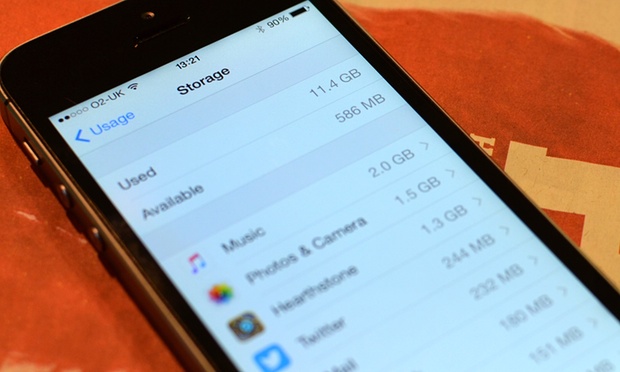
The problem is that 16GB is not enough storage for today’s smartphones. After formatting and the OS being installed, this ends up providing around 12GB of storage space for the user.
Back in 2012 the average app size was 23MB. Retina screens have significantly increased that size because each app has to have much higher-resolution imagery, which take up more room. Apps are also more complex, do more and provide richer experiences – everything that’s good about a vibrant app ecosystem - but they’re also taking up more space in the process.

Apple increased the largest app size to 4GB this year, meaning a single app can take up a quarter of the space on the normal iPhone. Not every app is massive, of course. Facebook weighs in at 95.2MB, Twitter 62.7MB, Snapchat 52.9MB and the Guardian’s app is 24.7MB.

That’s the size of the unopened installed app, but the moment it starts doing something – caching the images and data it needs to operate – the app sizes start to balloon.

The Twitter app, for instance, can easily hit more than 240MB, for a regular Twitter user. The Facebook app can grow easily to that size too, while many others including Apple’s own Messages app can start to put on data weight if users start sending photos.

Delete those photos


Speaking of photos, the iPhone 5S and 6 shoot 8MP photos that are just over 3MB in size each, which makes the average holiday, and the 200 or so photos that accompany it, a 600MB chunk of the storage.

The iPhone 6S now has a 12MP camera, which means larger photos that will take up more storage, and Apple’s new Live Photos will consume yet more space with their added video and audio. You can forget about shooting 4K video, which consumes around 300MB per minute. That 16GB of storage could easily be filled with just photos, let alone everything else.

There are ways to offload those photos onto cloud storage, of course, but most users do not do that by default and are simply forced to delete some.

What about music? Most people use their smartphone to listen to some sort of music, and while streaming is labelled as the answer, our 3G and 4G networks are not everywhere and cannot always be relied upon to sate our thirst for music.

An average album of 12 tracks stored on an iPhone from Apple’s own iTunes music store or Apple Music takes up around 90MB of storage. A 200-track playlist, therefore, takes up around 1.5GB of storage or around 12% of a 16GB iPhone.

That’s without talking about other media such as the movies and TV shows on offer from Apple’s various stores; we’ll gloss over those that weigh in at around 1GB per movie.

Gaming cost


The biggest offenders, of course, are games. Even a small game such as Apple’s current favourite Crossy Road, weighs in at 74.7MB of space before being opened. Angry Birds 2 takes up 91.6MB, Candy Crush Saga 55MB and the critically acclaimed Monument Valley demands 275MB without the Forgotten Shores expansion pack.

Those are all small compared to graphically rich games such as Real Racing 3, which claims at least 855MB of your storage. Even a card game such as Blizzard’s popular Hearthstone demands a minimum of 868MB of storage. An avid player of Hearthstone, for instance, with all the latest content will need at least 1.3GB of space on their smartphone.

The average user had 27 apps on their iPhone at the end of 2013 according to data from Nielsen, which means with apps growing in size and photos, music and videos becoming more compelling that 12GB of space seemed small last year, let alone today.

Running out of storage makes the smartphone behave poorly and provides a very unsatisfactory user experience. Users are forced to delete precious memories, tracks they might want to listen to or apps and games that they can no longer afford to keep on your phone, and that might just be to install an update.

Given that Apple does not allow users to add storage with removable cards, if it cared about the user experience of the vast majority of its users it should have increased the storage capacity of the starting iPhone.

Analyst firm IHS estimated that storage cost Apple $0.42 per GB of storage. Adding an extra 16GB of storage to bring it to 32GB would have cost Apple just $6.72 extra per smartphone, something it could have easily eaten within its profit margins – the biggest in the industry by miles.

The iPhone 6S and 6S Plus are premium smartphones, which Apple claims are the “most advanced smartphones in the world”. Yet the rest of the industry, including arch-rival Samsung, has woken up to the fact that 16GB is not enough storage these days and either allows users to add their own storage to top-end smartphones or provides at least 32GB of rated space for their base models.

In 2015, anyone who buys a 16GB smartphone risks quickly running out of space or being forced to pick and choose what apps they use. That’s a problem for the user, but it’s a problem for Apple too - its iPhone 6S innovations won’t be seen as as good as it thinks they are if users quickly run out of space to store their 4K videos