Tuesday, September 13, 2016

The 4 Best Apps To Organise Your Phone's Photos

These four apps are specifically built to organise your photos with very little effort at all.


1) Focus

Focus (Android) lets you take the same approach with your photos that you might do with your Gmail, giving you a customisable labelling system to quickly group your pictures into any kind of bucket you like: photos of the kids, photos from a particular trip, photos with you in them, or just photos that stand out from the rest in your camera’s picture gallery.

2) Cleen

If you’ve ever wanted to sort through your photos using the same at-a-glance appraisals and finger swipes you use to find dates on Tinder, you’re in luck. Cleen (iOS) lets you swipe up to save photos, swipe down to trash them, and swipe left or right if you don’t want to decide right away. There are no albums, no labels, and no extra fuss.


3) Slidebox

Slidebox (Android and iOS) also lets you keep or delete images with a simple swipe of the finger. Additionally, you can place your pictures into specific albums with a tap on the screen, and it has a few more features than Cleen (like an easy album creation menu).


4) Photo File
Photo File (iOS) takes a slightly different approach to sorting your pictures. It asks you to categorise them before you actually take them. You use the app’s own camera to take pictures, and just above the shutter button is the label you’re about to apply. A swipe to the left or the right changes the category, and a tap on the shutter button takes the photo.

Monday, December 14, 2015

What are custom phone skins?

The custom phone skins refer to a thin layer of film which sticks to the surface of the mobile phone, for the purpose of decoration as well asprotect the phone from scratching. The most commonly used material for the custom phone skins are vinyl films, which is no harm to humans and environmental protection. For good quality vinyl films that stick to the mobile phone, they can be easily removed manually without leaving any residue on the cover. Also, good quality custom skins for mobile phone are good for heat dissipating when the mobile phone cover becomes hot due to the mobile phone's CUP occupation is high such as when watching movies or playing games on the smartphone.

Generally speaking, there are 2 different types of custom phone skins.One is the printed phone skins with custom design picture. Another one is directly cut by special texture films without printing.

For the printed custom skins, usually people like to print personal photo or group photo to make it personalized. DAQIN provide high quality white printing design films that can be directly printed by 6 colors inkjet printer. The printing design films from DAQIN are very special. As you know, ordinary vinyl films can't be printed by inkjet printer while DAQIN managed to do it. The ink for 6 colors inkjet printer are dye ink, which has high quality printing effect and the cost for each printing is comparatively low.

After printed, the film needs to be laminate with a thin layer of lamination effect film in order to become water proof and add special textures such as leather, gridding, twill, 3D water drops, glossy, matte, flash-matte, ice-flower…etc.It's cold lamination, no need of turn on heat during the lamination process. DAQIN provide 4 rollers laminator which can effectively avoid bubble. Still, it needs several times of practicing before you become familiar with the operation of laminating.

After lamination, it's time to cut the film into custom phone skins with DAQIN's phone skin software and cutter. Any brand and model of mobile phone is OK! In less than 30 seconds, the cutting process will be completed and we can take the film out of the cutter and then pear off the sticker from the backing paper of the film.

At last, we can manually apply the custom skins on mobile phone for your customers. Or, we can ship the end product of custom phone skins to the customer who buy it in your online store.

For the production of the special texture custom skins for smartphones, it's easier and faster than printed custom skins. By selecting mobile phone brand and models and put the special texture film into the cutter, and then click cut button in the software it will start cutting the film into your custom phone skins.

Monday, November 16, 2015

Keeping Your Iphones With Right iPhone Cases

The importance of buying a right phone cover is many times missed out by people because they do not give a good look at what size would be right which is highly exemplified by Iphone cases. Since Iphones have become a highly sought after mobile phone in all over the world, their accessories are being prepared by many manufacturers. People from all over the world are proud of their precious possession and therefore they try to conserve their phones by buying best Iphone cases.
Almost every year, a new model of this phone is being introduced by the company for being used by people. Each new phone is having something better than the previous one and this involves keeping in mind a number of features. Starting from the shape of the phone to the individual technical features, everything is unique with the Iphone and therefore, a number of reasons have working it its favour. Iphone 4 is the newest model to hit the market and has instantly become a hit amount the Iphone users. Their show is quite beautiful with plenty of features in them and they also require a number of accessories to make it complete.

Iphone 4 cases are required for the newest model of phones because this is having slight variations in its shape and size, and hence the right case will be required to fit it inside. If there is a slight change in the shape of the cover for Iphone, then it will not fit into the cover and there will be an odd looking covering. To not let such a thing happen, people need to keep their Iphone cases of the best fit which will add to the beauty of the phones.

Nowadays, people are using this case to cover their phones and are buying them from different sources. They are making it a point to cover their phones properly with the Iphone 4 cases of the right fit, so that there is a proper covering from various angles. They should be careful not to buy the fake ones because they will not fit properly into the covers and also there can be damages while trying to fit in the Iphone.

There might be scratches on the screen if people try to forcibly fit their phones into such cases. Apart from being sensitive to rough surfaces, the sides of the phones can get hit if they fall with being inside Iphone cases. This will lead to breakage which is not going to happen if the cases are selected rightly. Plenty of such Iphone 4 cases are found in the market but people need to choose the right one, which will fit into the covers and will maintain the shape and size of these valuable phones.

Wednesday, October 14, 2015

Why Apple shouldn’t be selling a 16GB iPhone 6S or 6S Plus

With its latest 16GB iPhone 6S and 6S Plus Apple has answered the question of what it thinks really matters: profit or user experience?


The new iPhones are resplendent with new features, despite being the “tock” year in Apple’s “tick, tock” update cycle and looking exactly the same as last year’s iPhone 6 and 6 Plus.

But the 3D Touch screen, the better camera, the Taptic engine and the faster processors all hide one thing – the starting iPhone 6S and 6S Plus, costing £539 and £619 respectively, still only come with 16GB of storage.

The iPhone has come with 16GB of storage since 2010’s iPhone 4. Apple presumably wants to keep a lower price point to market its phones at, and to be able to upsell customers to the 64GB version - generating an extra £80 in revenue.

Almost all companies do precisely this, including Apple’s main handset rival Samsung. And you can argue that users have a choice – pay more to get more – but the vast majority don’t appreciate how small 16GB now is. They just want an iPhone and buy whatever they’re given by default, which is usually the cheapest.

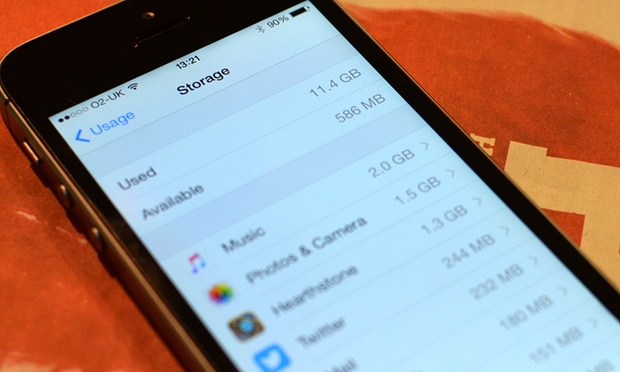
The problem is that 16GB is not enough storage for today’s smartphones. After formatting and the OS being installed, this ends up providing around 12GB of storage space for the user.
Back in 2012 the average app size was 23MB. Retina screens have significantly increased that size because each app has to have much higher-resolution imagery, which take up more room. Apps are also more complex, do more and provide richer experiences – everything that’s good about a vibrant app ecosystem - but they’re also taking up more space in the process.

Apple increased the largest app size to 4GB this year, meaning a single app can take up a quarter of the space on the normal iPhone. Not every app is massive, of course. Facebook weighs in at 95.2MB, Twitter 62.7MB, Snapchat 52.9MB and the Guardian’s app is 24.7MB.

That’s the size of the unopened installed app, but the moment it starts doing something – caching the images and data it needs to operate – the app sizes start to balloon.

The Twitter app, for instance, can easily hit more than 240MB, for a regular Twitter user. The Facebook app can grow easily to that size too, while many others including Apple’s own Messages app can start to put on data weight if users start sending photos.

Delete those photos


Speaking of photos, the iPhone 5S and 6 shoot 8MP photos that are just over 3MB in size each, which makes the average holiday, and the 200 or so photos that accompany it, a 600MB chunk of the storage.

The iPhone 6S now has a 12MP camera, which means larger photos that will take up more storage, and Apple’s new Live Photos will consume yet more space with their added video and audio. You can forget about shooting 4K video, which consumes around 300MB per minute. That 16GB of storage could easily be filled with just photos, let alone everything else.

There are ways to offload those photos onto cloud storage, of course, but most users do not do that by default and are simply forced to delete some.

What about music? Most people use their smartphone to listen to some sort of music, and while streaming is labelled as the answer, our 3G and 4G networks are not everywhere and cannot always be relied upon to sate our thirst for music.

An average album of 12 tracks stored on an iPhone from Apple’s own iTunes music store or Apple Music takes up around 90MB of storage. A 200-track playlist, therefore, takes up around 1.5GB of storage or around 12% of a 16GB iPhone.

That’s without talking about other media such as the movies and TV shows on offer from Apple’s various stores; we’ll gloss over those that weigh in at around 1GB per movie.

Gaming cost


The biggest offenders, of course, are games. Even a small game such as Apple’s current favourite Crossy Road, weighs in at 74.7MB of space before being opened. Angry Birds 2 takes up 91.6MB, Candy Crush Saga 55MB and the critically acclaimed Monument Valley demands 275MB without the Forgotten Shores expansion pack.

Those are all small compared to graphically rich games such as Real Racing 3, which claims at least 855MB of your storage. Even a card game such as Blizzard’s popular Hearthstone demands a minimum of 868MB of storage. An avid player of Hearthstone, for instance, with all the latest content will need at least 1.3GB of space on their smartphone.

The average user had 27 apps on their iPhone at the end of 2013 according to data from Nielsen, which means with apps growing in size and photos, music and videos becoming more compelling that 12GB of space seemed small last year, let alone today.

Running out of storage makes the smartphone behave poorly and provides a very unsatisfactory user experience. Users are forced to delete precious memories, tracks they might want to listen to or apps and games that they can no longer afford to keep on your phone, and that might just be to install an update.

Given that Apple does not allow users to add storage with removable cards, if it cared about the user experience of the vast majority of its users it should have increased the storage capacity of the starting iPhone.

Analyst firm IHS estimated that storage cost Apple $0.42 per GB of storage. Adding an extra 16GB of storage to bring it to 32GB would have cost Apple just $6.72 extra per smartphone, something it could have easily eaten within its profit margins – the biggest in the industry by miles.

The iPhone 6S and 6S Plus are premium smartphones, which Apple claims are the “most advanced smartphones in the world”. Yet the rest of the industry, including arch-rival Samsung, has woken up to the fact that 16GB is not enough storage these days and either allows users to add their own storage to top-end smartphones or provides at least 32GB of rated space for their base models.

In 2015, anyone who buys a 16GB smartphone risks quickly running out of space or being forced to pick and choose what apps they use. That’s a problem for the user, but it’s a problem for Apple too - its iPhone 6S innovations won’t be seen as as good as it thinks they are if users quickly run out of space to store their 4K videos

Wednesday, September 23, 2015

Apple iPhone 6S and 6S Plus review roundup: stronger, faster, heavier

Apple’s new iPhone 6S and 6S Plus smartphones land in customers hands on Friday, but a select bunch of reviewers have been given early access.
The Guardian is not one of those picked by Apple to receive a sample of the iPhone 6S and 6S Plus ahead of its release, and will publish a review after buying one at the same time as consumers.

In the meantime, here is a quick roundup of the general opinion on Apple’s latest.
Review: Apple’s iPhone 6s And 6s Plus Go ‘Tick’ - Tech Crunch

Matthew Panzarino sees quite an uptick in performance of this year’s iPhone over the iPhone 6, in its “tick-tock” upgrade cycle:

    In our tests, there was a 56.5% increase in Geekbench benchmark scores from the iPhone 6 Plus to the iPhone 6s Plus. That follows a 97% increase from the iPhone 5 to the iPhone 5s.

    In comparison, there was only a 24.9% increase from the iPhone 5s to the iPhone 6.

    In terms of performance, the ‘tock’ years are really kicking the ‘tick’ years in the butt.

iPhone 6S review: Apple’s 3D Touch screen and camera improvements make the best better - Digital Spy

Despite the iPhone 6S being thicker and heavier than its predecessor, Matt Hill found it wasn’t noticeable.

    No need to grumble, this is still slim by any standard, with the phone’s increased portliness barely noticeable and the added 14g giving the phone a more reassuring heft. Easily the most well constructed handset on the market - despite increased competition from the likes of the Samsung Galaxy S6 and HTC One M9 - the iPhone 6S’s cool-to-the-touch metal body and softly curved edges make the phone look and feel great.

iPhone 6S review: Apple presses forward - The Verge

Nilay Patel loves the new pressure-sensitive “3D Touch” screen but admits that it’s not exactly a novel concept, even if it’s a new implementation:

    On the home screen, app icons can show quick actions when you push them. Pushing on a calendar entry shows you more information about it, and pushing on a map pin lets you jump straight to directions. Pushing on a message in Mail opens a preview that you can slide to either side to delete or archive, and pushing harder opens the message. It’s the same in Safari: pushing lightly on a link opens a preview, and pushing slightly harder actually opens the page.

    It’s not some insane lightning bolt of inspiration; Google is doing something very similar with Material Design and Microsoft has been sliding things all over the screen since someone was drunk enough to approve the name ‘Windows Phone 7 Series’. But 3D Touch [is] by far the most aggressive and interesting step in this direction anyone has ever taken.

iPhone 6s Review: A Slightly Better iPhone 6 - The Wall Street Journal

The camera’s better, the processor is faster and it has a new screen, but the battery life of the iPhone is still poor, according to Joanna Stern:

    Let’s get this out of the way first. The No. 1 thing people want in a smartphone is better battery life. And the iPhone 6s doesn’t deliver that.

    The 4.7-inch 6s will get you through the day, but you’ll struggle to make it til bedtime with moderate to heavy use. And it seemed to drain even faster than my 6 when I used the new processor-intensive camera features like Live Photos. The bigger 5.5-inch 6s Plus lasted longer and is the best choice if you’re a heavy user and want some juice left over at the end of the day.

I Used The Crap Out Of The New iPhone 6S And This Is What Happened - BuzzFeed Life

Writing for BuzzFeed Life (not BuzzFeed News, that’s below) Nicole Nguyen found Apple’s marketing a little distasteful:

    The marketing slogan for the 6S is “The only thing that’s changed is everything,” which is funny because that’s, well, not true. Take a look at the hardware. It’s impossible to tell the difference between the 6S and 6 iPhones, save for a tinyyy [sic] ant-sized “S” on the rear and slightly more heft (the 6S phones are one ounce heavier). They’re fraternal twins that basically look like identical twins.

    What is different are the few, significant internal improvements, one of which is what I think will entice people (namely, me) to upgrade. 3D Touch is the 6S’s killer feature. But it depends on what apps decide to support it.

Yet Another iPhone 6s Review - BuzzFeed News

John Paczkowski found images shot by the 12-megapixel camera were generally better, as you would expect.

    The photos I’ve taken with the new 12 megapixel rear camera on the iPhone 6s look a little bit better than the ones I’ve taken with the 8 megapixel one on the iPhone 6 — and even my not-at-all-a-photographer’s eye can see that.

    Apple says this is because of “improved local tone mapping” and an “advanced pixel technology” called Focus Pixels. It probably is. I don’t care. What matters is that pictures of my daughters look warmer, sharper, more detailed, whatever. And they look equally good when I blow them up.

iPhone 6S Plus review: Is bigger better? - Pocket-Lint

Stuart Miles says the optical stabilisation and phase detection autofocus make the new 12-megapixel upgrade to the iPhone’s camera a winner, but Live Photos are a mixed bag for now.

    A lot of Live Photos we’ve shot have footage of us hastily dropping the camera after taking the shot. Another frustration is that audio is automatically recorded, which at times is lovely - a child’s giggle for example - but not so great when you’ve got the same child screaming in the background.

    All that extra video adds to their size too, meaning a Live Photo is worth around two still photos in terms of space. While you can offload some of that to Apple’s iCloud Drive service (at a yearly subscription) a 16GB iPhone 6S Plus isn’t going to stretch as far as it used to (compounding the argument for a 32GB minimum model).

iPhone 6S Review: Come for the New Features, Stay for the Screaming Speed - Bloomberg

Speed is at the heart of the new iPhones for Sam Grobart, including the new and improved fingerprint scanner:

    The Touch ID sensor is instantaneous: By the time you’ve pressed the home button to wake up the phone, you’ve already authenticated yourself and are on the home screen.

iPhone 6s review: built for success - The Telegraph

According to Rhiannon Williams, the always-listening “Hey Siri” feature needs a bit of work learning to ignore everyone but you:

    Thanks to the integrated A9, Siri is now always on, waiting to be activated by the command “Hey Siri”. This is attuned to your voice when you first set Siri up during the iPhone activation process, which means Siri is supposed to be able to pick out your voice alone from within a crowded room. I did find that a woman of a similar age and voice range to myself was able to activate Siri from a distance by speaking a command, so maybe this is a feature which needs a bit of refining.

iPhone 6s Plus review: more battery, better camera and a bigger screen mean new phone could win you round to huge phones - The Independent

And of that Rose Gold colour, apparently it’s difficult to photograph and looks better in real life, says David Phelan.

    The rose gold, by the way, looks better in the flesh than in photos, thanks to a colour that is understated and warm rather than out-and-out pink.

iPhone 6S review - Tech Radar

Gareth Beavis sees the upgrade as a no-brainer if money is no object, but it’s a much more difficult call for most people.

    It’s still one of, if not the, most expensive flagship phones on the market, and as such needs to impress in every way, which the iPhone 6S doesn’t quite do. The iPhone 6 remains on sale at a lower price, and the difference between it and Apple’s latest phone is negligible.

Tuesday, September 8, 2015

Huawei G8 With Metal Body, Fingerprint Sensor Launched at IFA 2015

Huawei at its IFA 2015 event in Berlin launched the new Mate S smartphone. The Chinese manufacturer alongside also revealed the new G8 smartphone.
Huawei has announced that the new G8 will be available in several markets starting this month at a recommended retail price of EUR 399 (approximately Rs. 30,000). Some of the markets where the Huawei G8 will be available include China, Egypt, Germany, Malaysia, Taiwan, Saudi Arabia, and United Kingdom among others.

The new G8 smartphone will be available in Dark Silver, Gold, and White colours. For specifications, the Huawei G8 comes with a 5.5-inch full-HD display and features a 2.5D curved Gorilla Glass. The handset features an all metal body, a highlight of the G8.

Another highlight is the fingerprint scanner at the back of the handset. Huawei notes that the G8 smartphone sports Fingerprint Sense 2.0. The dual-SIM handset supports 4G LTE on both the SIM cards.

There is a 13-megapixel rear camera with sapphire protection around the sensor. The rear camera also features built-in OIS, RGBW sensor, ISP Foodie mode, and makeup mode. Under the hood, the Huawei G8 is powered by an octa-core Qualcomm Snapdragon 615 processor coupled with 3GB of RAM and comes with 32GB inbuilt storage. It supports expandable storage via microSD card (up to 64GB).

Running Android 5.1 Lollipop with Emotion UI skin on top, the handset is backed by a 3000mAh battery.

The Huawei Mate S, on the other hand, also launched at IFA 2015, is the first smartphone featuring Force Touch display, which can distinguish between a light tap and deep press.

Monday, August 24, 2015

Samsung and Apple battle over the smartphone ‘floating voter’

Samsung and Apple are fighting over the technology world’s equivalent of the “floating voter”, according to Samsung’s president of UK and Ireland.

Andy Griffiths said customer loyalty to the two companies means most people never consider switching between Android and iOS, so the brands are actually competing for only 20% of customers in the UK.
Phablets are the name of the game as Samsung and Apple trade blows over the 20% of the market that actually switches. Photograph: Donald Bowers/Getty Images
“There are groups of people who stick with what they like, whether that’s Samsung or Apple, and then there are there are people in the middle that you can kind of sway, a bit like the floating voter, and that’s who we’re all fighting for,” Griffiths told the Guardian, as Samsung unveiled its new Galaxy S6 Edge+ and Note 5 devices.

“We hold about two-thirds of the Android base in the UK and we have a very high level of retention. The fact is that it’s a two-brand market and I think people are choosing to go both ways, so we’re always going to be trading customers between us.”

Data from research firm Consumer Intelligence Research Partners suggests that a similar situation exists in the US, where in the past two years 20% of iOS users switched to Android, and 16% of Android users switched to iOS.

Making these switches has become easier, with cross-syncing services helping people to take their personal information such as calendars, contacts and email accounts from one platform to another. Most popular apps are also now available on both platforms.

Smartphone saturation driving ‘kick down’ in sales

The battle for these “floating voters” has intensified as smartphone penetration has reached saturation point in markets like the UK and US, where most people who are likely to buy a smartphone already have one.

That has led to a dip in global sales for Samsung, which, like Apple, is facing up to the challenge of persuading people to upgrade to a newer handset.

“Overall saturation means a kick down in the market as it settles,” said Griffiths. “Once it reaches its new rhythm people will want a better phone than last time, and that step up is what we’ve seen in the UK.”

He added that in the UK, Samsung has helped to grow the premium market – smartphones costing upwards of £400 – by more than 30% since its Galaxy S6 launched in March, and expects that pattern to continue until Christmas.

A growing proportion of that premium market is made up of phablets – smartphones with screen sizes larger than 5.5in. Phablets accounted for 21% of US smartphone sales in the first quarter up nearly four times year on year, according to data from Kantar Worldpanel.

“The phablet category is three times bigger this year than last, and we believe there’s exponential growth in that size of smartphone, with one in 10 of every smartphone sold being 5.5in or above,” said Griffiths.

Phablets here to stay

Phablets also command some of the highest prices in the smartphone market, providing the biggest margins for smartphone manufacturers, explaining why both Apple and Samsung are pushing the supersized smartphone category so hard.

Griffiths said: “If you look at the proportion of the business by value in the premium end, phablets are a substantial sector and something we wanted to add to the recovery in our business in 2015.”

The odd thing about Samsung’s device lineup this year, however, is where and when it is launching its Note 5 phablet.

The Note line pioneered this category back in 2011, but its latest model does not yet have a UK launch date, making its debut instead in the US and Asia. In the UK, Samsung is relying on its 5.7in Galaxy S6 Edge+ for now.

One thing is clear, phablets aren’t going anywhere in the near term, with Griffiths admitting that phone screen size is increasing because “almost one of the last things you do on a smartphone is make a call”.